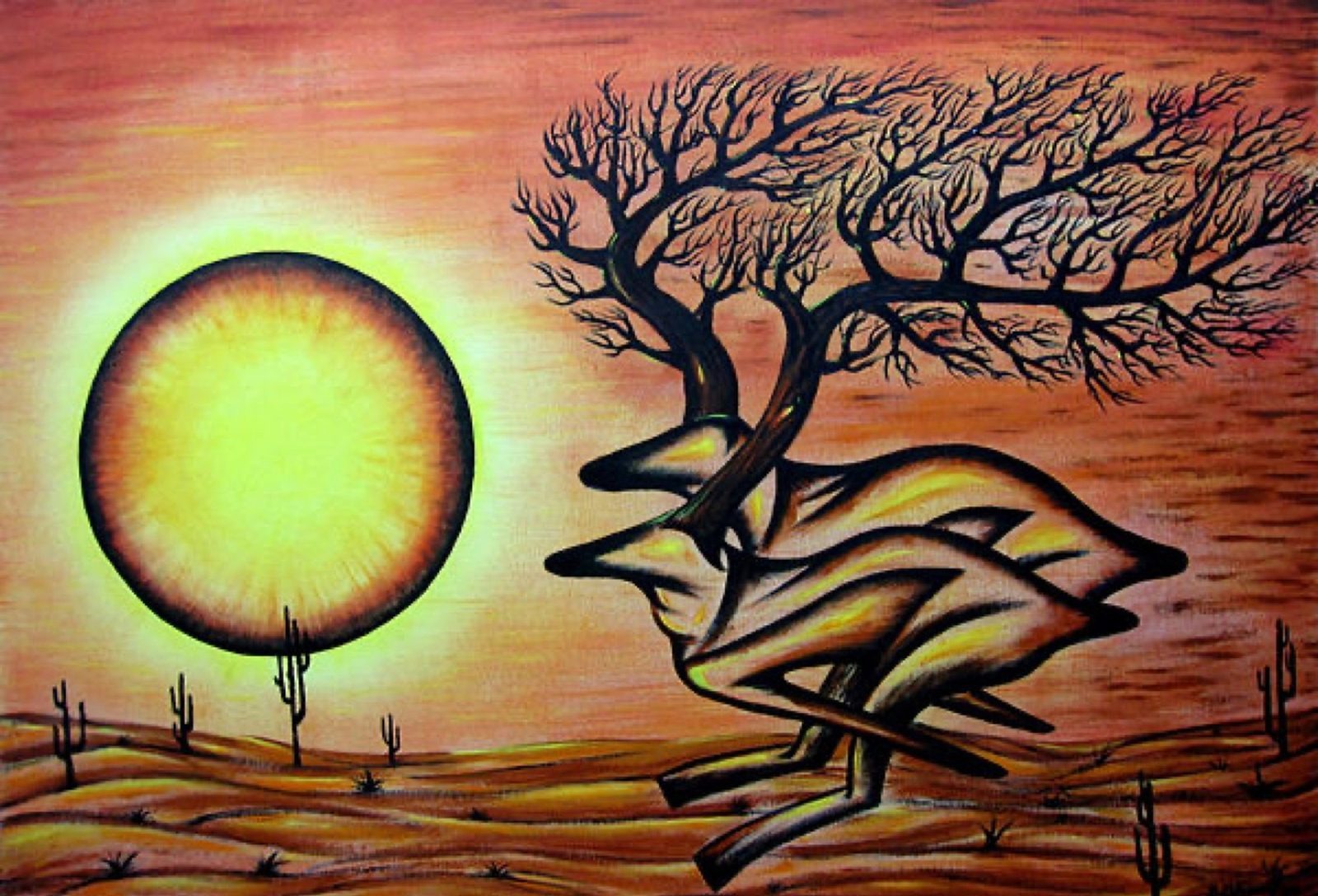
Some paintings you finish in weeks. Some stay with you for years, because they hold a place and a time you do not want to lose. Desert Sun is that kind for me. I painted it in 2010, and it is one of the earliest works I still have available. When I look at it today, I see light I grew up with, and light I was learning to live under in California.
Where the painting began
I was born in Egypt, where the desert is never far away. Even in the city, the sun shapes the day — when you work, when you travel, when stone and sand turn gold in the late afternoon. Desert light is strong and honest. It shows every edge, every crack, every color at full strength.
When I came to California, I found a familiar light waiting for me. Riverside, where I live and paint, has bright mornings, dry hills, and evenings that go warm and gold before the sun drops. It is a different desert, but the feeling is related. Desert Sun began in that meeting point: an old memory of Egyptian heat, seen again under a California sky.
Painting heat you can feel
Anyone can paint a yellow circle and call it the sun. That was never what I wanted. I wanted to paint what the sun does — how it warms a wall, how it lifts dust into the air, how it makes warm colors glow from inside.
So I built Desert Sun, 28 by 40 inches in oil on canvas, in layers. Oil paint lets me lay a warm ground, let it dry, then work over it with glazes and thicker passages until the surface holds depth. Some areas stay smooth and bright. Others carry texture, so the painting changes as the light in your room changes through the day.
A desert is not flat, and sunlight is not flat. At noon it is hard and white. In the evening it is deep and golden. A good painting should hold more than one hour of the day inside it. When collectors tell me Desert Sun feels warmer in the evening, I know the layers are doing their work.
Why I stayed with abstract
I could have painted a landscape — dunes, a horizon, a single tree. But memory does not work like a photograph. When I remember the desert, I do not first remember a shape. I remember a feeling on my skin, a brightness in my eyes, a quiet that is bigger than any one place.
Abstract painting lets me put that feeling first. The warm field in Desert Sun is not one dune or one sunset. It is many days of heat and light, gathered into one canvas. That is why it sits so well in a living room. It does not tell a literal story that fights with your furniture. It brings warmth, energy, and a center the eye can return to.
Over the years my work has grown in scale and confidence — a painting like Three Fishes, 48 by 48 inches in oil on wood, carries a room with bold, clear forms. Desert Sun is earlier and quieter, but the same question is already there: how can color alone hold a life? Seeing the beginning next to the later work shows you the road I have traveled as a painter.
An early work, still here
Most paintings from that period are gone — sold, given, or kept in private hands. Desert Sun stayed. Part of that is chance. Part, I think, is that I was never in a hurry to let it go. An early painting is a document. It shows the hand before habits formed, reaching for something it could not yet name.
For a collector, that has special value. You are not only buying a warm desert abstract. You are buying a starting point — a 2010 canvas from an artist still painting, whose later murals and large works grew from experiments like this one. Every painting of mine is a single original, never printed, signed by my hand. There will never be another Desert Sun like this one.
If your room needs warmth without noise — a painting that glows rather than shouts — this is the one I would show first. Hang it where morning or evening light can meet it, and let it do what desert light has always done for me: make an ordinary day feel larger and more alive.
Looking for the right piece for your wall? Write to me at [email protected] — tell me about your room and I will help you find the painting that belongs there, and tell you the story behind it.